When winter hits, drivers often worry about everything electrical—from batteries to sensors.
It’s natural to ask the same question about lighting: do LED headlights struggle in cold weather the way car batteries do?
The short answer is yes, LED headlights work in cold weather—and in many ways, they perform even better than traditional bulbs.
That said, winter introduces a unique challenge that surprises many drivers: snow and ice buildup on the headlight lens.
Understanding both sides helps you decide whether LEDs are the right choice for winter driving.
Why LEDs Actually Perform Better in the Cold
LEDs are semiconductors, not heated filaments. That difference matters a lot in winter.
In cold temperatures, LED luminous efficiency increases. Lower ambient temperatures help LEDs operate closer to their ideal conditions, reducing stress on internal components.
Key winter advantages of LEDs include:
Higher efficiency in low temperatures
Instant-on performance, even below freezing
No warm-up delay, unlike HID systems
Stable light output during cold starts
Unlike halogen bulbs, which waste energy as heat, LEDs convert more electrical energy directly into light.
Cold air helps keep internal junction temperatures lower, which can extend LED lifespan and maintain consistent brightness.
This is one reason LEDs are widely used in industrial, outdoor, and cold-environment applications.
Cold Start Performance: LEDs vs. Other Technologies
Winter mornings expose weaknesses in many lighting systems.
Halogen bulbs: Turn on immediately, but suffer reduced efficiency in extreme cold.
HID headlights: Often dim or color-shift during cold starts and need time to warm up.
LED headlights in cold weather: Turn on instantly at full brightness, regardless of temperature.
For drivers dealing with icy mornings and short daylight hours, this instant, reliable output is a major safety advantage.
The Main Winter Challenge: Snow and Ice Buildup
Here’s where LEDs face a real-world tradeoff.
Halogen bulbs emit a significant amount of forward-facing infrared heat. That heat warms the headlight lens, helping melt snow and ice during driving.
LED headlights work differently.
While LEDs generate heat internally (at the chip and driver), very little heat reaches the lens surface. As a result:
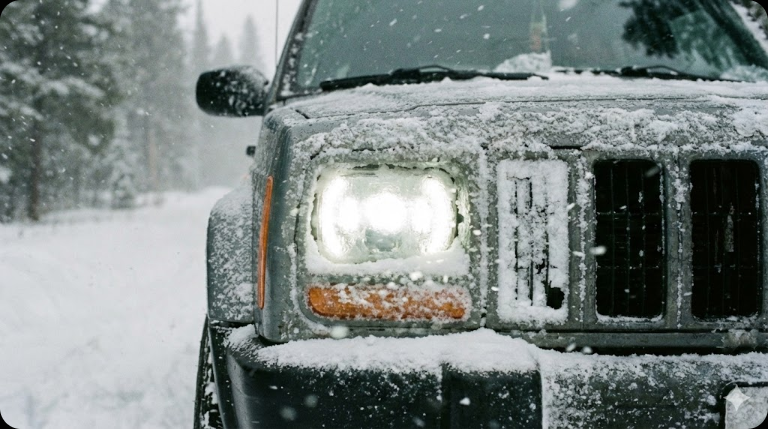
Snow can accumulate on the headlight cover
Ice may form during heavy snowfall
Light output can be partially blocked even though the LED is working perfectly
This issue has nothing to do with LED reliability—it’s a byproduct of their efficiency.
In severe winter conditions, a clean LED headlight can become snow-covered faster than a halogen one.
Practical Solutions to the “Ice Factor”
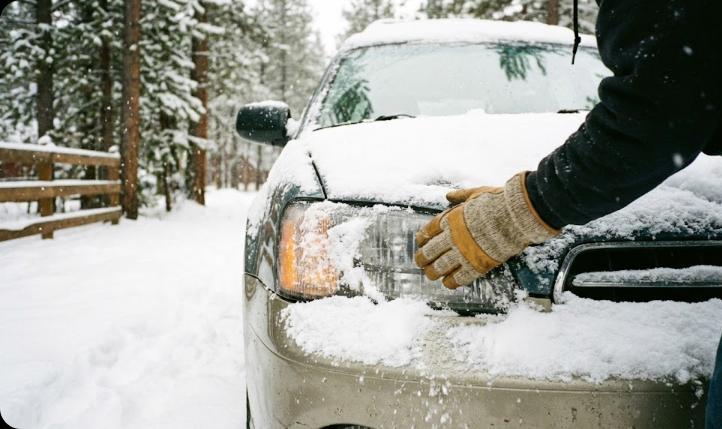
Fortunately, snow buildup is manageable with a few practical steps.
How drivers reduce snow buildup on LED headlights:
Manually clear lenses during fuel or rest stops
Apply a hydrophobic coating (such as Rain-X) to reduce snow adhesion
Use vehicles or headlight assemblies designed with heated lenses (common in newer models)
Ensure LED cooling fans or vents are not blocked by frozen slush
It’s also important to distinguish between internal heat (which LEDs have) and external lens heat (which LEDs lack). Proper thermal management protects the LED itself, but it does not warm the lens surface.
LED vs. Halogen in Winter: A Balanced View
Pros of LEDs in winter:
Excellent cold start performance
Stable brightness in freezing temperatures
Higher efficiency and lower electrical load
Long-term reliability in cold climates
Tradeoff to manage:
Increased risk of snow buildup on the lens surface
For most drivers, the benefits outweigh the drawbacks—especially with basic winter maintenance habits.
Final Verdict
So, do LED lights work in cold weather?
Absolutely.
LED headlights in cold weather offer reliable starts, strong illumination, and excellent efficiency.
As long as drivers remain aware of snow buildup and keep lenses clear, LEDs are often a better winter lighting solution than halogen or HID systems.
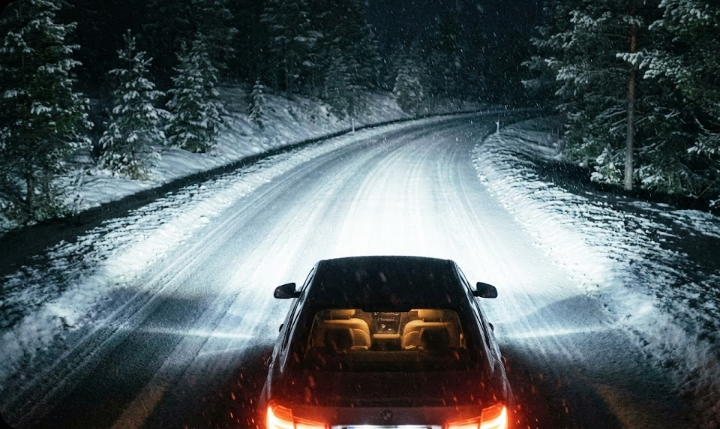
In winter driving, visibility comes from consistent light—and LEDs deliver exactly that.


