LED Headlight Cooling: Double Copper Tube + Fin Explained
31 December 2025
by
Reading volume: 698

Heat is the silent killer of most aftermarket LED headlights. You can install a 100W+ H11 or 9005 LED headlight bulb, but without proper cooling, junction temperatures spike, brightness drops, and lifespan tanks.
That’s why professional LED headlight manufacturers now rely on Double Copper Tube + Fin designs for high-power car lights.
Understanding Heat in LED Headlights
High-power LED headlamp bulbs aren’t just light sources—they generate massive heat at the CSP chip junction. Heat moves in three ways:
Conduction: Through the PCB substrate, thermal paste, and heat sinks. Copper has superior thermal conductivity (~400 W/m·K) versus aluminum (~200 W/m·K).
Convection: Air moves heat away, either naturally via fins or actively using fans.
Radiation: Minor in LEDs but relevant in enclosed housings.
Keeping the LED junction temperature under 85°C–95°C is critical. Exceed this, and lumen depreciation accelerates. That’s why raw car headlight lumens don’t tell the whole story—lux on the road is what counts.
Double Copper Tube + Fin: How It Works
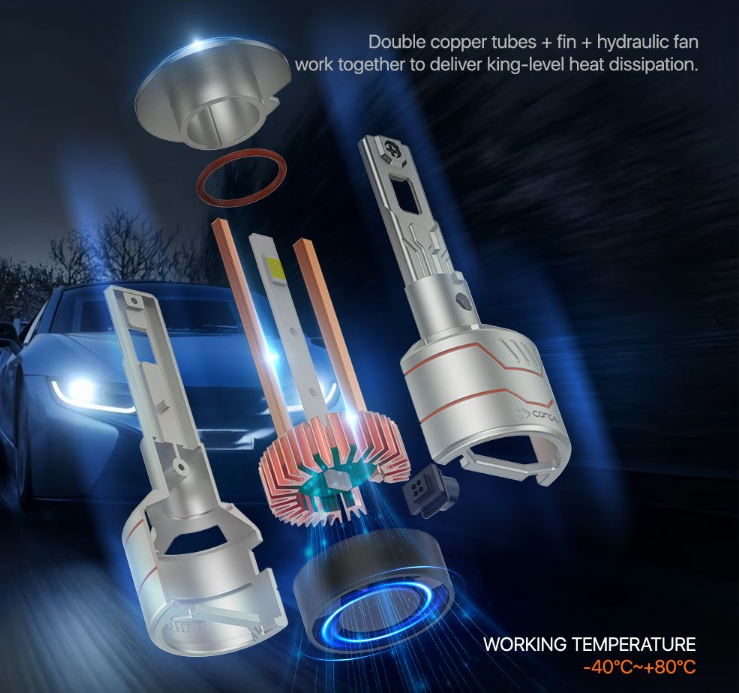
Our Double Coper Tube + Fin system combines phase-change liquid cooling and air dispersion:
Dual Copper Tubes: Liquid evaporates at the hot CSP chip, travels to the cooler end, condenses, and releases heat. Two tubes double heat-carrying capacity.
Aluminum Fins: Spread the heat into the surrounding air, enhancing automotive lighting heat dissipation.
CSP Chip Integration: Thin CSP chips are mounted directly over the copper pipe with premium thermal paste, reducing hotspots.
The result: safe junction temperatures, minimal lumen loss, and consistent brightness for H11 LED bulbs, 9005 headlight bulbs, or other auto car LED lights.
Active Fan Cooling: Pros and Cons
Fans are still used but can’t do the job alone:
Dual Ball Bearing vs. Hydraulic Fans: Dual ball bearing fans spin at 12,000 RPM but create noise. Hydraulic fans are quieter and last longer.
Thermal Throttling: Poor fans trigger automatic dimming if heat isn’t removed fast enough.
Hybrid Designs: Combining Double Copper Tube + Fin with a high-speed silent fan ensures steady cooling for low beam headlights, high beams, and fog lights.
The takeaway: even the best H11 LED bulb or 9005 LED headlight bulb won’t last if cooling is insufficient.
Why Cheap Bulbs Fail
Most failures aren’t caused by the LED itself—they stem from poor thermal design:
Uneven or thin thermal paste increases resistance.
Small aluminum fins cannot handle high-power heat.
Oversized COB chips produce hotspots, reducing the beam quality in projector lens headlights.
Even a high-lumen H7 LED headlight is useless if the junction temperature exceeds 120°C in 30 minutes. Buyers often mistake high lumens for good performance, but high lux LED headlights are what really matter.
Factory Testing: Engineering Reality
At our automotive LED headlight factory, every high-power LED headlight undergoes rigorous thermal testing:
Thermal Imaging Cameras: Monitor heat in real-time to identify hotspots.
48-Hour High-Temperature Aging Test: Continuous operation in 60°C environments simulates harsh conditions.

Beam Pattern Validation: Ensures proper light projection for projector lenses and prevents dim headlights or scattered light.
Lux vs. Lumens Analysis: Lux measures usable road illumination; raw lumens can be misleading.
For OEM automotive lighting partners, verified thermal performance data is more important than flashy marketing images.
Practical Buying Advice for B2B and Enthusiasts
When sourcing high-power LED headlight bulbs or LED headlight kits:
Confirm Double Copper Tube + Fin thermal management.
Check junction temperature ratings (≤ 90°C for 100W+ bulbs).
Ensure high-speed silent fan integration.
Evaluate lux vs. lumens—practical brightness matters more than numbers.
Verify compatibility with projector lens headlight cars or reflector housings.
Consider trusted LED headlight suppliers and LED headlight manufacturers with proven stable lighting OEM experience.
Even small details, like correct LED headlight adjustment or 360-degree adjustable LED installation, make a huge difference in low beam headlights, high beams, and fog lights performance.重试 错误原因
Common Issues and FAQs
Why are my headlights so dim even with new bulbs?
Likely causes: poor thermal management, misaligned CSP chips, or inadequate heat dissipation in projector lens headlight car setups.
Are yellow bulbs legal for fog lights?
3000K yellow fog lights are widely used. Legality depends on local regulations, but yellow light penetrates fog better than 6000K cool white.
Can I replace halogen H7 or H11 with LED in projectors?
Yes, but use CSP chip LED bulbs designed for projector retrofits. Thin chips and proper alignment maintain sharp cut-off lines.
What’s better: LED vs Bi-LED or COB for projectors?
CSP chips are preferable for bi-LED projector headlights to minimize shadows and maintain uniform beam patterns. COB chips may create hotspots.
Key Technical Takeaways
Double Copper Tube + Fin outperforms solid aluminum in heat transfer by 50x.
Hybrid cooling (liquid + fan) ensures safe LED junction temperature.
CSP chips maintain sharp beams in projector lenses.
Lux matters more than lumens for real-world driving.
Proper LED headlight adjustment prevents dim headlights and glare.


