You’re crawling down a night trail.
The tires kick up thick dust. The air turns hazy. Your powerful white light bar fires up—and suddenly all you see is a glowing wall right in front of your hood.
Sound familiar?
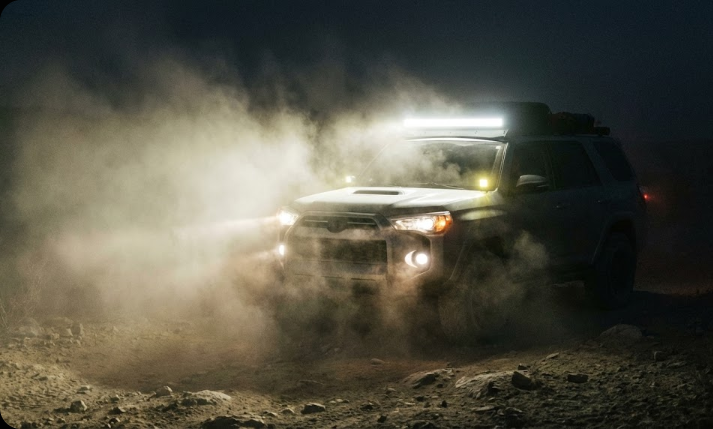
It’s not a style choice. It’s physics. And once you understand it, the reason why off-roaders use yellow lights becomes obvious.
The Science Behind the “White Wall” Effect
When you drive off-road, visibility isn’t limited by darkness alone. It’s limited by particles in the air—dust, fog, sand, snow, or rain.
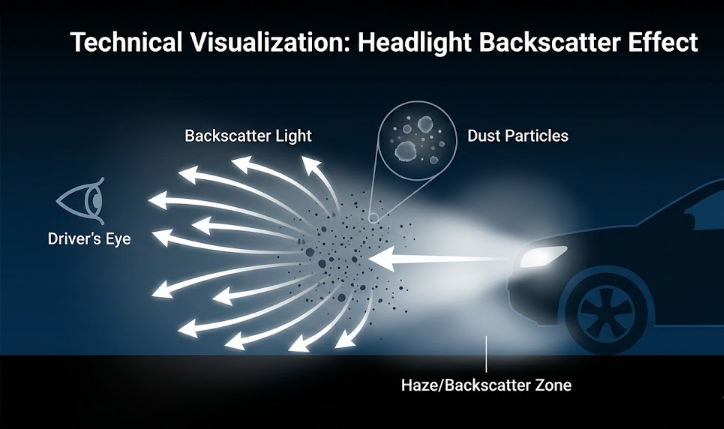
This is where Backscatter becomes the enemy.
Why white light fails
White LED light contains a high amount of blue wavelengths. Shorter wavelengths scatter more easily when they hit tiny particles in the air.
Light to bounce straight back into your eyes
A bright haze in front of the vehicle
Rapid eye fatigue
Loss of depth perception
Instead of lighting the trail, your lights illuminate the dust itself.
That’s why high-output white light bars often perform worse in real off-road conditions than expected.
Why Yellow and Amber Light Works Better
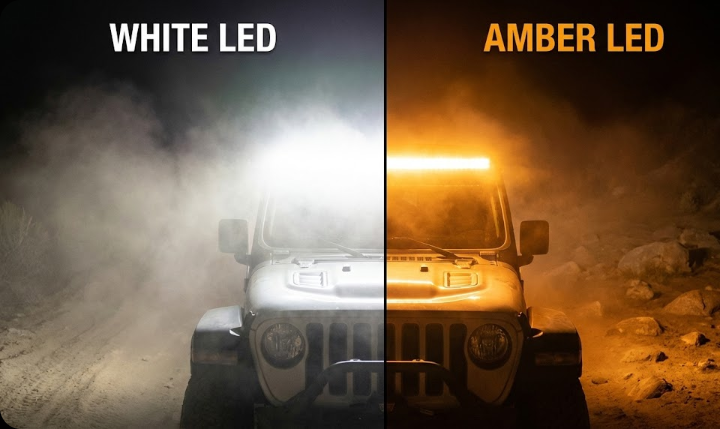
Selective yellow lighting uses longer wavelengths that scatter less in particulate-heavy environments.
When amber off-road lights hit dust or fog:
Less light reflects back toward the driver
More light continues forward
The beam appears to “cut through” the air
This is why yellow lights feel calmer and clearer even at lower output levels.
In dusty convoys, amber lights dramatically improve off-road visibility, allowing drivers to see terrain rather than airborne debris.
Better Terrain Contrast on the Trail
Off-road driving isn’t about lighting up everything—it’s about seeing detail.
White light often looks impressive, but it tends to wash out contrast.
Under intense white illumination:
Rocks blend into the ground
Ruts flatten visually
Surface texture disappears
Yellow light works differently.
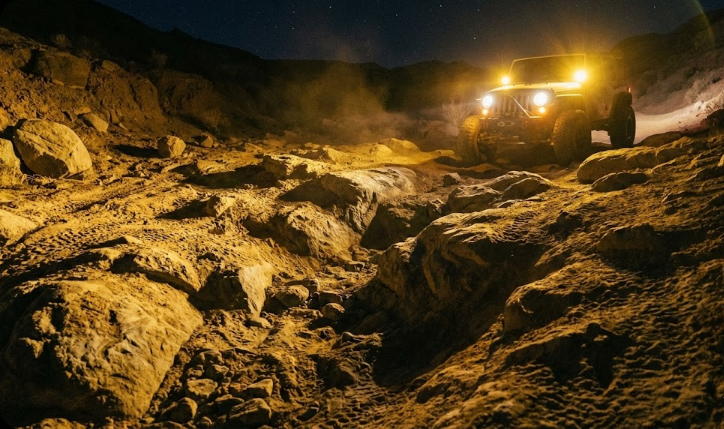
Because it reduces glare and sharpens edge definition, amber lighting helps your eyes detect:
Shadow transitions
Depth changes
Surface irregularities
This improved contrast makes it easier to choose the correct line over rocks, through sand, or along forest trails.
That’s why many experienced drivers report feeling more confident driving slowly with yellow lights than fast with bright white ones.
Dust vs. Fog: Real-World Use Cases
Yellow lights aren’t meant to replace white lights. They complement them.
In dust
When driving in groups, dust hangs in the air continuously. White lights reflect back instantly, while amber lighting minimizes reflection and maintains forward visibility.
This is why many rigs run:
White lights for open, clean air
Amber lights for dusty convoys
In fog and mist
Low-mounted amber lights function effectively as fog and dust lights, illuminating the road surface without reflecting upward into moisture.
Amber covers: a flexible solution
Many off-roaders use removable amber covers on white light bars. This allows quick adaptation when conditions change—white when clear, amber when visibility drops.
Yellow Lights Reduce Driver Fatigue
Brightness alone doesn’t equal comfort.
Constant glare forces your eyes to continuously refocus, leading to visual fatigue. Yellow light reduces harsh reflections and creates a more relaxed visual environment.
On long trails or multi-hour night runs, this difference matters more than raw lumen output.
Final Thoughts: A Tool, Not a Trend
Yellow lights aren’t a fashion statement. They’re a visibility tool.
The best off-road lighting setup isn’t one color—it’s a system.
White light for distance and speed
Amber light for dust, fog, snow, and technical terrain
This balanced approach is why serious off-roaders rely on yellow lighting when conditions get difficult. When visibility disappears, clarity—not brightness—is what gets you home safely.


