LED vs HID Headlights in Real Driving Conditions
06 March 2026
by Conpex
Reading volume: 1152
Picture a dark highway at 70 mph. No streetlights. No traffic. Just you, the road, and whatever your headlights can reveal.
This is where the debate around LED vs. HID headlights becomes real—not on a spec sheet, but on asphalt.
Both technologies are capable of high output. Both claim superior performance. But they behave very differently once installed in actual vehicles.
The truth? LED and HID (Xenon) systems excel in different environments. Understanding those differences helps you choose based on how and where you drive—not just marketing numbers.
Light Intensity & Throw – The HID Edge
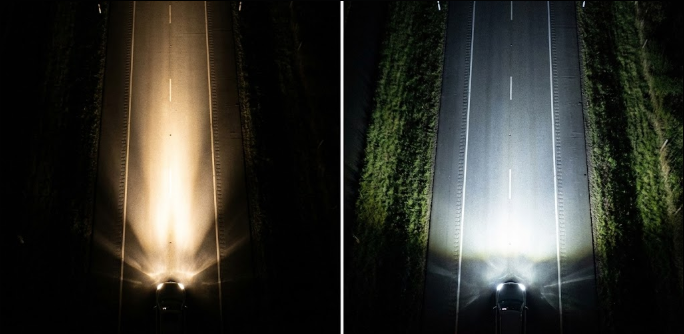
When discussing Xenon vs. LED performance, one area where HIDs often stand out is long-distance headlight throw.
HID bulbs generate a powerful arc of light inside a capsule filled with xenon gas.
This arc emits light in nearly 360 degrees, allowing projector lenses to fully utilize the reflector geometry. The result is a concentrated hot spot down the road.
Key characteristics of HID systems:
Strong central beam intensity
Long-range visibility on highways
High luminous flux concentrated into a focused beam pattern
On dark rural roads or high-speed highways, many drivers find that HID systems provide superior distance illumination. The beam penetrates far ahead, increasing reaction time at speed.
However, this strength comes with trade-offs.
One major limitation is warm-up time. HID systems require 5–15 seconds to reach full brightness after ignition.
During that period, output ramps up gradually—a noticeable delay if you’re frequently switching beams or starting the vehicle.
Responsiveness & Peripheral Vision – The LED Edge
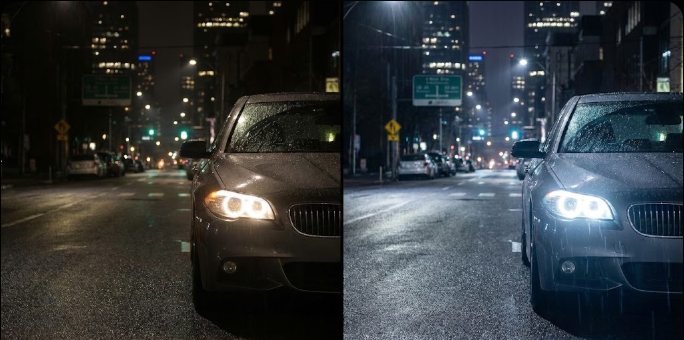
LED systems approach lighting differently.
Instead of an arc, LEDs use semiconductor diodes arranged on precise substrates. Their biggest advantage is immediate response.
LED headlights offer:
Instant full brightness
Zero warm-up time
Consistent output during rapid switching
In city driving or suburban commutes, this instant-on behavior enhances safety. There’s no waiting for full output when you start the car or activate high beams.
Another advantage is beam width. Many LED systems are engineered to provide broader peripheral coverage. That means:
Better illumination of road shoulders
Improved side-of-road visibility
Earlier detection of pedestrians or wildlife
For drivers concerned about night driving visibility in mixed environments—urban streets, intersections, suburban neighborhoods—this wider distribution can feel more comfortable and controlled.
LED systems also tend to operate at cooler color temperatures (5000K–6000K). While visually crisp, the cooler tone may not always be ideal in wet conditions.
Weather Performance & Durability
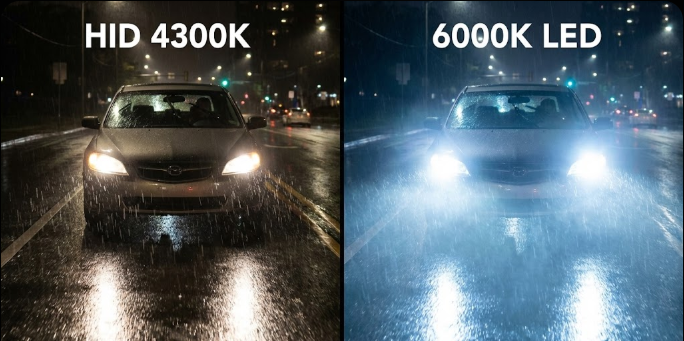
Bad weather separates marketing from physics.
HID systems are commonly available in 4300K–5000K color temperatures. Slightly warmer tones often provide a better Color Rendering Index (CRI) and improved depth perception in rain or mist.
Cooler 6000K+ LED systems can create more reflection and glare in fog due to light scatter. That said, many modern LED systems now offer warmer variants to mitigate this issue.
From a durability standpoint:
LEDs typically last 30,000+ hours
HIDs generally last 2,000–5,000 hours
HID systems also rely on ballasts—external components that manage voltage. These ballasts can fail over time and add complexity to the system.
LED systems use drivers instead, which are generally more compact and simpler to install. In daily-use vehicles, lower maintenance and longer lifespan often favor LEDs.
Final Verdict: Which Should You Choose?
When comparing LED vs. HID headlights, the decision depends on driving style.
Choose HID if:
You drive long highway distances regularly
Maximum forward throw is your priority
You value strong central beam intensity
Choose LED if:
You commute daily in urban or suburban environments
Instant response and low maintenance matter most
You prefer broad peripheral visibility
Both technologies are capable. The key is matching the system to real-world use—not just chasing brightness numbers.
In lighting, application matters more than hype.


