Driving in a snowstorm can quickly turn hazardous. Visibility plummets, lane markings vanish,
and swirling snowflakes reflect light backinto your eyes. In these moments, many drivers experience a “whiteout” effect—where everything ahead of the car appears uniformly bright, yet nothing is truly distinguishable.
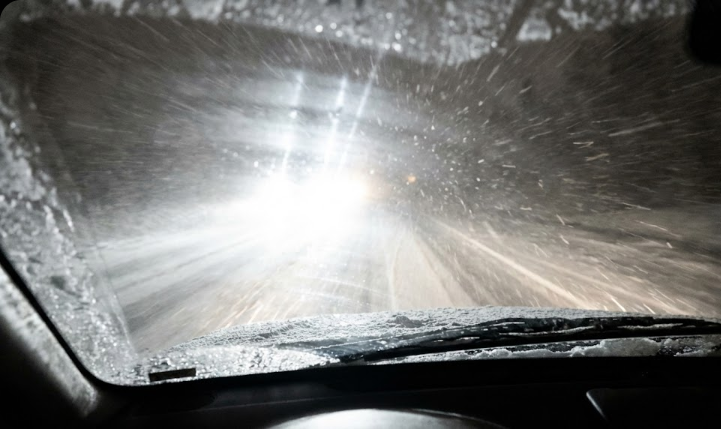
This raises an important question: Is brighter and whiter light really better when driving on snow-covered roads?
The answer lies not in brightness alone, but in color temperature and how light behaves in winter conditions.
The Physics of Backscatter in Snow
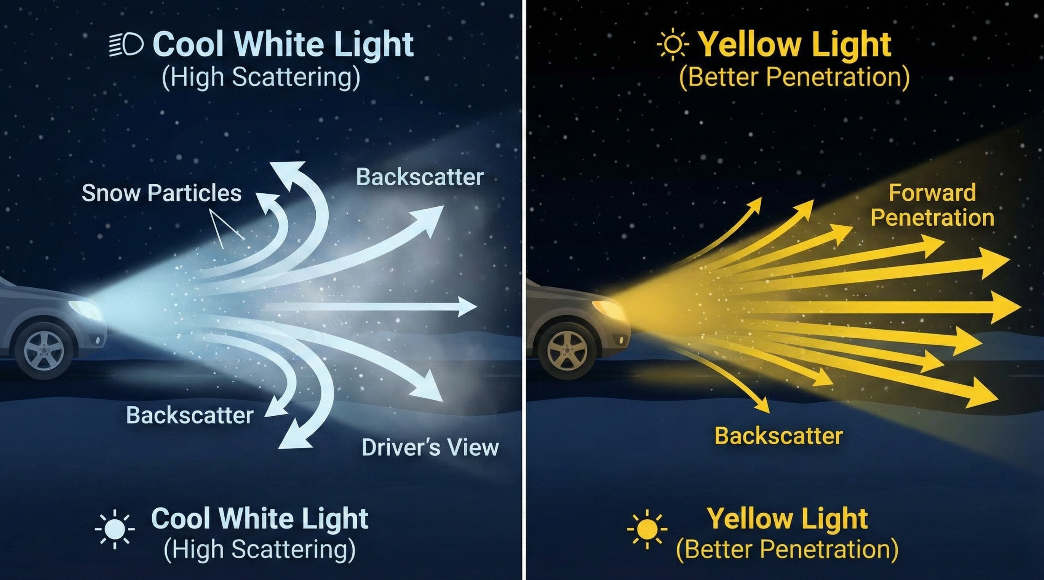
Snow consists of countless tiny ice crystals suspended in the air. When your headlights hit these crystals, light does not simply pass through—it reflects and scatters in all directions.
This phenomenon is known as backscatter.
Why cool white light underperforms in snow
Headlights with a high Kelvin rating—typically 6000K or higher—contain more blue wavelengths. These shorter wavelengths scatter far more easily when they strike snowflakes and ice particles.
The result are:
Strong reflection bouncing directly back into the driver’s eyes
A glowing “wall of white” directly in front of the vehicle
Diminished contrast and depth perception
Faster eye fatigue
This is why many drivers with 6000K LED headlights report that their lights look extremely bright, yet visibility actually feels worse during snowfall.
In snowy conditions, more white does not mean more visibility.
Yellow and Warm White: Why They Work Better
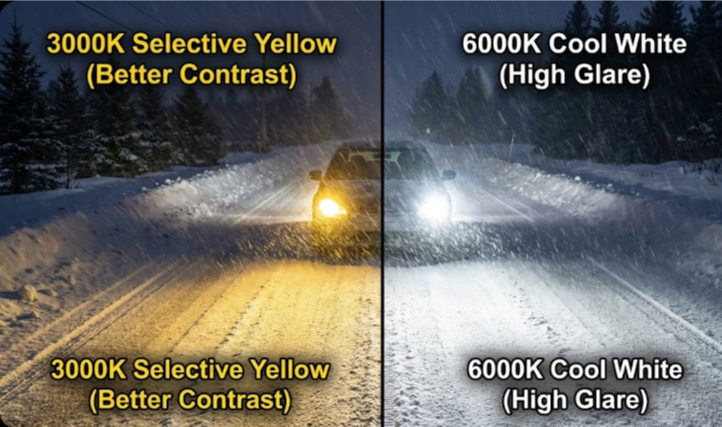
When it comes to winter driving, the goal is not maximum brightness—but usable contrast.
Selective Yellow (3000K)
3000K yellow light, often referred to as selective yellow, uses longer wavelengths that scatter less in snow.
Key benefits include:
Reduced backscatter from falling snow
Less glare reflecting back to the driver’s eyes
Improved visibility of road edges and tire tracks
Sharper definition of reflective lane markers
This is why yellow has long been the preferred choice for fog lights in snowy and severe winter conditions.
Warm White (Around 4300K)
For drivers who prefer a light closer to natural white, 4300K warm white offers an excellent balance.
Compared to pure white or blue-tinted light, 4300K provides:
Noticeably better contrast on snow-covered roads
Less glare than 6000K lighting
More comfortable vision during long winter drives
When comparing yellow vs. white light for winter, warm white strikes a comfortab balance between performance and everyday usability.
The Ideal Compromise: 4300K–5000K
While 3000K yellow performs extremely well in heavy snow or fog, many drivers do not want yellow headlights year-round.
This leads to our most practical recommendation:
Best all-around color temperature for snow
For most drivers, the ideal solution is:
Low beams: 4300K–5000K (warm to neutral white)
Fog lights: 3000K yellow
This setup offers flexibility:
Warm white headlights provide clear visibility in normal winter conditions
Yellow fog lights can be activated specifically when snow becomes heavy
Reduced eye strain compared to blue-tinted light
Better contrast against white road surfaces
From a safety standpoint, this combination minimizes light scattering while preserving comfortable night driving across in all seasons.
Why 6000K+ Is Not Ideal for Winter
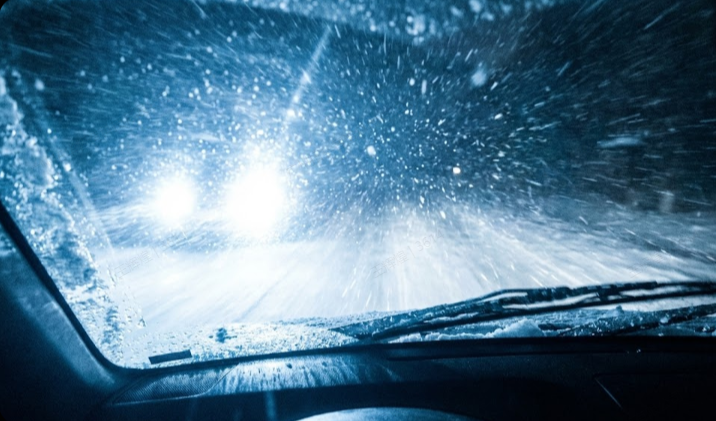
Although popular for their appearance, 6000K+ headlights are not designed for winter performance.
Their drawbacks in snow include:
Increased glare from backscatter
Lower contrast on snow-covered terrain
Faster visual fatigue
Poor depth perception in falling snow
This is why many winter-driving experts recommend avoiding the blue end of the light spectrum entirely when selecting the best headlight color for snow.
Final Verdict
So, what color headlight is best for snow?
Best for heavy snow and fog: 3000K selective yellow
Best year-round winter compromise: 4300K–5000K warm white
Least suitable: 6000K+ cool white or blue-tinted headlights
No matter which color you choose, remember this crucial point:
proper headlight aiming is just as important as color temperature.
Well-aimed, warm-toned headlights will always outperform misaligned, ultra-white lights when winter conditions turn dangerous.


