What Is the Lifespan of LED Headlights?
16 January 2026
by Conpex
Reading volume: 1198
For decades, drivers have chased the idea of a “fit-and-forget” headlight—the mythical bulb that never needs replacing.
As vehicles grow more complex and maintenance costs rise,longevity has become one of the strongest selling points of LED headlights.
Manufacturers often advertise exceptionally long service lives, sometimes claiming tens of thousands of hours.
For car owners weighing halogen,HID and LED upgrades, the key question is simple: How long do LED headlights really last in the real world, and what determines their lifespan?
To answer this properly, we need to separate laboratory ratings from on-road reality.
The “50,000-Hour” Benchmark Explained
If you’ve researched LED headlights, you’ve almost certainly seen the 50,000-hour rating. This number sounds impressive—and it is—but it’s often misunderstood.
Where the Number Comes From
Stable voltage supply
Optimal ambient temperatures
Zero vibration
Perfect heat dissipation
Continuous, steady operation
Under these parameters, LED chips can maintain usable light output for an extremely long time.
What Does 50,000 Hours Mean in Driving Terms?
To put this into practical perspective:
2 hours of night driving per day
→ ~730 hours per year
→ 50,000 hours ≈ 68 years
1 hour per day
→ 50,000 hours ≈ 137 years
Clearly, no vehicle will remain in service that long. This is why LED longevity is so appealing on paper—it far exceeds the practical lifespan of the car itself.
Comparison With Other Lighting Technologies
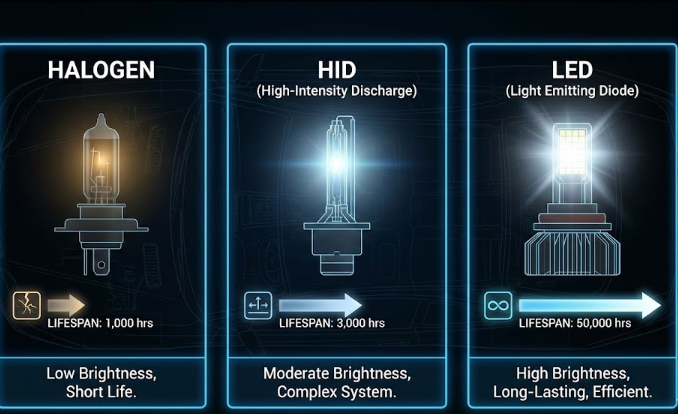
To fully understand LED’s appeal, it helps to compare typical lifespans across automotive lighting options:
Halogen bulbs:
~500–1,000 hours
Often replaced multiple times over a vehicle’s life
HID (Xenon) bulbs:
~2,000–5,000 hours
Longer life than halogen, but still finite
LED headlights:
Rated up to 30,000–50,000 hours
Potentially “lifetime” lighting—if conditions are ideal
The catch? Real-world driving conditions are rarely ideal.
Real-World Factors That Shorten LED Lifespan
This is where theory meets reality. The actual lifespan of LED headlights is heavily influenced by design, installation, and real-world use.
Heat Management: The Primary Enemy
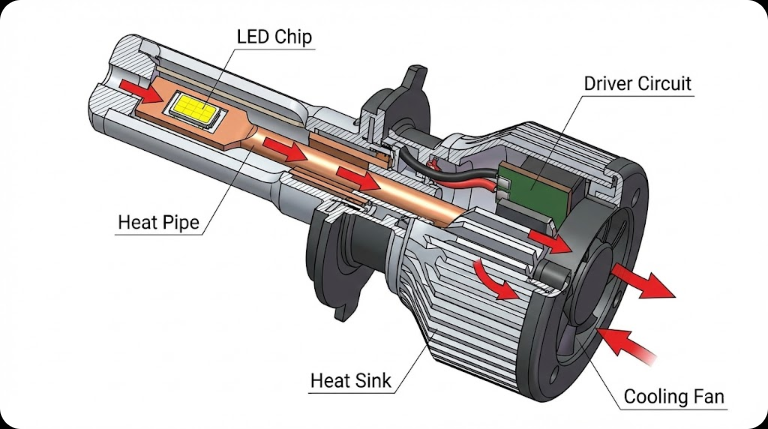
Heat is the single most critical factor affecting LED longevity.
While LEDs are more energy-efficient than halogens, they still generate significant heat—just not in the form drivers expect. Instead of radiating heat forward,
LEDs concentrate heat at the junction point (where the semiconductor meets the circuit board).
If this heat is not dissipated efficiently:
The LED chip degrades at an accelerated rate
Light output drops prematurely
Electronic components age rapidly
This is why heat dissipation is non-negotiable for automotive LEDs. Most high-quality LED headlights rely on:
Large aluminum heat sinks
Active cooling fans
Heat pipes or hybrid cooling designs
If airflow is restricted or cooling components fail, temperatures spike—and lifespan plummets dramatically.
Quality of Drivers and Voltage Regulation
In most LED headlight failures, the LED chip itself is not the weak point.
The real culprit is often the driver—the electronic module that regulates voltage and current to the LED. High-quality drivers:
Maintain a stable current supply
Protect against voltage spikes and surges
Filter out vehicle electrical noise
Cheap,low-quality drivers, by contrast, are vulnerable to:
Overheating
Solder joint fatigue
Component failure
In these cases, the LED may still be capable of producing light, but the electronics fail first—ending the usable life of the headlight long before the LED chip wears out.
Environmental Stress in Real Vehicles
Unlike lab tests, vehicles expose headlights to harsh, unforgiving conditions every day:
Constant vibration from the road
Moisture and condensation buildup
Dust and debris infiltration
Extreme temperature cycles in the engine bay
Over time, these stresses lead to common failures like:
Fan bearing wear (the top cause of cooling fan malfunctions)
Thermal paste degradation
Corrosion of electronic contacts
Even a well-designed LED system will age faster if these environmental factors are not accounted for in its engineering.
Lumen Depreciation: The “Silent” End of Life
One key difference between LEDs and traditional bulbs is how they fail —and it’s a difference that’s often overlooked.
LEDs Don’t Usually Burn Out
Halogen bulbs fail suddenly:the filament breaks, and the light goes out instantly. LEDs behave differently.
Instead of abrupt failure, LEDs experience lumen depreciation:a gradual, steady loss of brightness over time—often unnoticed by the driver at first.
This slow decline is why LEDs can seem to “last forever,” even when their performance is no longer optimal for safe driving.
Understanding the L70 Rating
LED lifespan is almost always defined by an L70 rating—an industry standard that means the LED has dropped to 70% of its original brightness.
The light still works, but its output is significantly reduced
For headlights, that 30% brightness loss translates to noticeably diminished visibility at night—especially on unlit roads or in adverse weather (rain, fog, snow).
Signs Your LED Headlights Are Reaching the End
Even without total failure, aging LED headlights show clear warning signs—almost always linked to driver or cooling system issues, not the LED chip itself:
Flickering or intermittent operation
Color shifting(often becoming more bluish or purple)
Noticeable dimming compared to when new
Unusual cooling fan noise (or complete fan failure)
How to Maximize the Lifespan of LED Headlights
If longevity is your top priority, these practical choices make a dramatic difference in LED headlight life:
Prioritize robust cooling
Active cooling (fans) offers better heat control but has moving parts
Passive cooling is simpler but requires a high-quality, well-designed heat sink.
Avoid ultra-cheap kits
Poor electronics and inadequate thermal design are the top causes of early LED failure.
Ensure correct professional installation
Proper seating and alignment improve airflow;
incorrect installation traps heat and accelerates component wear.
Opt for realistic brightness levels
Overdriven LEDs run hotter and degrade far faster-brightness does not equal safety if it sacrifices longevity.
Final Verdict: Is the Lifespan Worth It?
So, what is the real lifespan of LED headlights?
Under ideal laboratory conditions, LED headlights last far longer than halogen or HID systems—potentially the entire life of the vehicle.
In the real world, their longevity depends far less on the LED chip itself and far more on three critical factors: thermal design, electronics quality, and resistance to environmental stress.
When these factors are engineered and executed properly, LED’s longer lifespan easily justifies its higher upfront cost. When they are not, the manufacturer’s advertised hour ratings mean next to nothing.


