Why LED Headlights Fail Early: Heat, Voltage, and Installation Errors
03 March 2026
by Conpex
Reading volume: 853
Why LED Headlights Fail Early: Heat, Voltage, and Installation Errors
LED headlights are often marketed with bold claims—30,000 hours, 50,000 hours, or even “lifetime” durability. Yet many drivers experience failure within a year.
So why do LED headlights fail early despite such impressive ratings?
The answer lies in a hard truth: the LED chip itself is durable.
The problem is the environment around it. Heat, unstable vehicle voltage, and improper installation create conditions that push the system beyond its design limits.
Understanding the science behind these failures helps you avoid repeating the cycle.
Reason 1: The Invisible Enemy – Heat
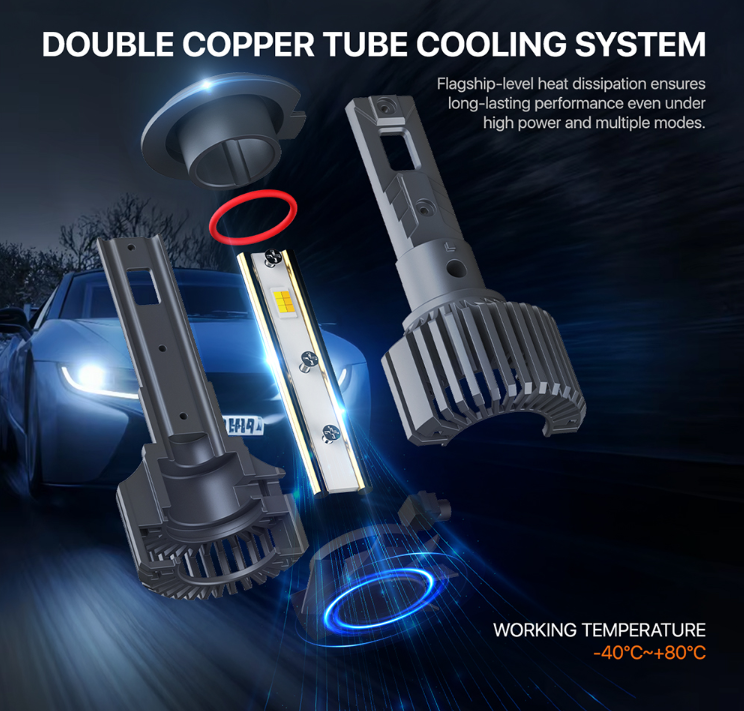
Unlike halogen bulbs, LEDs rarely “burn out” suddenly.
Instead, they degrade over time due to excessive junction temperature—the temperature at the microscopic point where the semiconductor produces light.
LEDs convert electrical energy into light efficiently, but not perfectly. The unused energy becomes heat, concentrated at the diode base.
If this heat is not removed quickly, the junction temperature rises beyond safe operating limits.
What happens when junction temperature climbs too high?
Accelerated semiconductor degradation
Lumen depreciation (gradual dimming)
Color shifting toward blue or purple
Driver instability and flickering
In extreme cases, prolonged overheating leads to thermal runaway.
This occurs when rising temperature increases electrical resistance, which generates even more heat, creating a destructive feedback loop.
Effective LED thermal management is therefore critical. Quality systems use:
Large aluminum heat sinks
Copper heat pipes
Active cooling fans
If airflow is blocked or fan quality is poor, heat cannot dissipate properly.
Even a well-built LED chip will fail prematurely if the surrounding heat dissipation system is inadequate.
Heat doesn’t destroy LEDs overnight—it slowly erodes performance until failure becomes inevitable.
Reason 2: Electrical Stress & Voltage Spikes
A vehicle’s electrical system is not a stable laboratory power supply. It is a harsh, fluctuating environment.
This “dirty power” can include:
Sudden surges during ignition
Ripple voltage from the alternator
Load-dump spikes during battery disconnect events
The LED chip cannot directly tolerate these fluctuations.
That responsibility belongs to the LED driver—the small electronic module that regulates current and protects the diode.
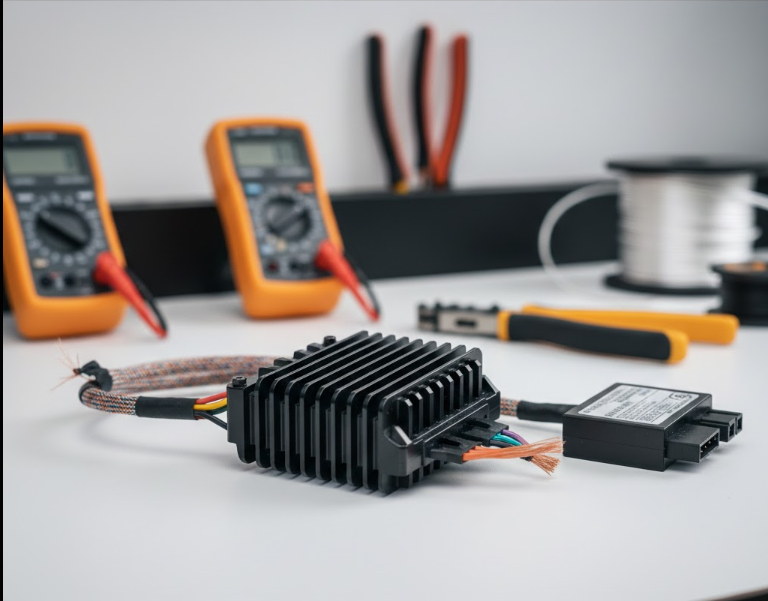
In high-quality systems, the driver:
Maintains constant current output
Absorbs transient spikes
Filters electrical noise
In low-cost kits, however, the internal driver is often undersized or poorly engineered. Over time,
repeated exposure to automotive voltage spikes overheats components, weakens solder joints, and eventually causes LED driver failure.
When the driver fails, symptoms appear as:
Random flickering
Sudden shutdown
Complete burnout
In many early failures, the LED chip is still functional—but the driver electronics have been “fried” by inadequate regulation.
Reason 3: Common Installation Mistakes
Even high-quality LED kits can fail early due to improper headlight installation.
Common errors include:
Blocking airflow with factory dust covers
Many LED bulbs require ventilation for proper heat dissipation. Sealing the housing without airflow traps heat inside, dramatically increasing junction temperature.
Loose or stressed wiring connections
Poor connections create electrical resistance, which generates localized heat and stresses the driver circuitry.
Touching the LED diodes during installation
Skin oils can contaminate optical surfaces and increase localized heat buildup on the chip surface.
Incorrect positioning
Improper mounting may reduce airflow or misalign cooling components.
Small installation details can determine whether an LED lasts years—or months.
Conclusion: Breaking the Cycle of Failure
If you’re wondering why LED headlights fail early, the answer is rarely the diode itself. Early failure is almost always caused by excessive heat, electrical instability, or installation mistakes.
Longevity depends on quality engineering + proper installation.
Choose LED systems with robust external drivers, effective heat dissipation techniques, and reliable cooling structures. Then install them carefully, ensuring airflow and secure wiring.
When heat and voltage are controlled, LED headlights can truly deliver the lifespan they promise.


