Why LED Headlights Perform Worse in Rain and Fog Than Expected
02 March 2026
by Conpex
Reading volume: 1217
You upgraded to high-output LEDs. The light looks bright, crisp, and modern.
Then the rain starts—or fog rolls in—and suddenly visibility drops. The road looks washed out. Lane markings fade. Everything ahead turns into a glowing haze.
This frustration is common with LED headlights in rain and fog. The issue isn’t that LEDs are weak. In fact, they’re often extremely powerful. The real culprit is physics.
Brightness (lumens) does not equal penetration.The way light interacts with water droplets determines what you actually see.
The Science of Scattering
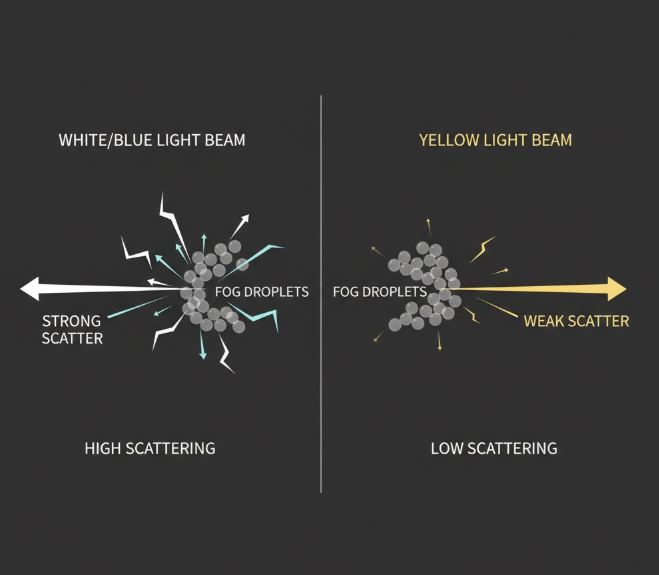
To understand the problem, we need to talk about Rayleigh scattering.
Light is made up of different wavelengths. Shorter wavelengths (blue light) scatter more easily when they hit small particles, such as:
Fog droplets
Rain mist
Snow crystals
Airborne moisture
Most aftermarket LEDs operate around 6000K or higher, producing a cool, blue-white appearance. These shorter wavelengths scatter aggressively when they encounter water droplets in the air.
As a result:
The beam spreads in multiple directions
Less light travels forward
More light reflects back toward the driver
This is why 6000K vs. 3000K for driving matters so much.
Warmer light (around 3000K–4300K) contains longer wavelengths (yellow/amber tones). These longer wavelengths scatter less and maintain better forward direction.
In rain and fog, white light doesn’t “cut through.” It bounces.
The “Wall of White” Effect
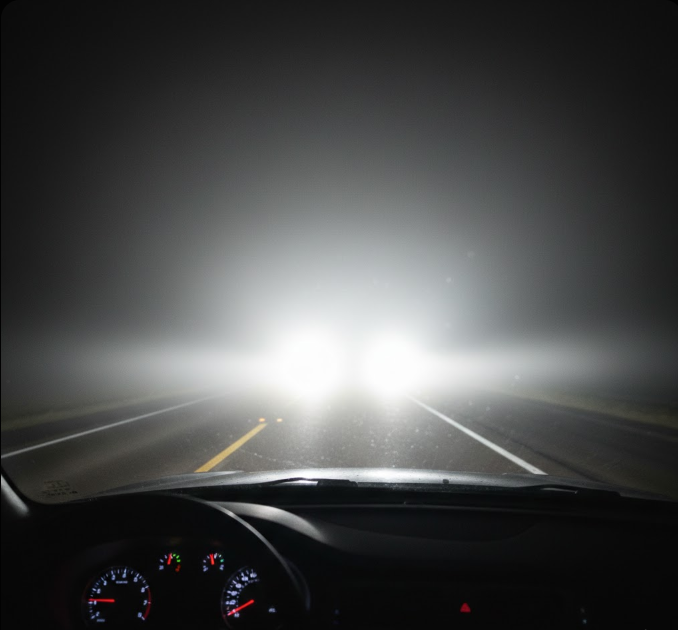
Another key factor is backscatter.
When intense white LED light hits rain or fog, it reflects directly back into the driver’s eyes. Instead of illuminating the road surface, the beam illuminates the moisture itself.
This creates what drivers often describe as a “white wall” effect:
A glowing haze directly in front of the hood
Reduced forward clarity
Increased glare
Faster visual fatigue
The brighter the light, the worse the effect can become.
High-lumen LEDs amplify this problem. The increased output produces more reflected light, which further reduces effective light penetration in fog.
Ironically, extremely bright LEDs can reduce usable visibility in bad weather.
The issue is not insufficient power—it’s uncontrolled reflection.
The Contrast & Depth Perception Problem
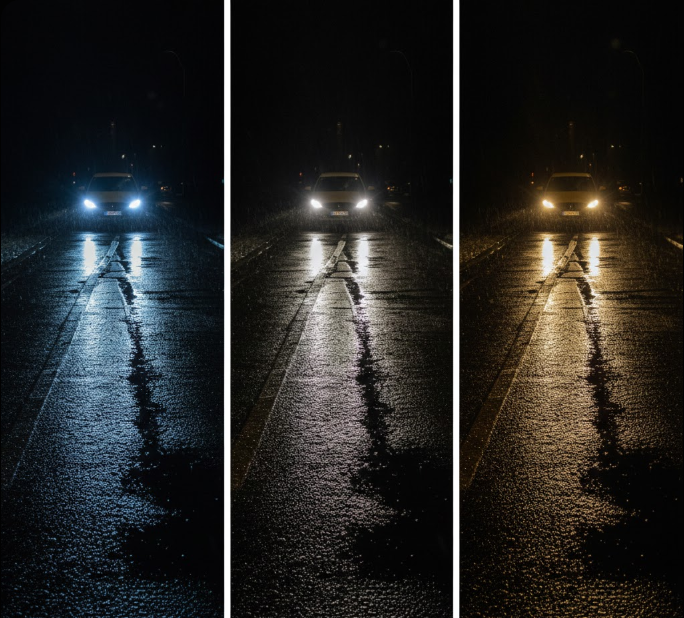
Even when light reaches the road, color temperature affects how well you interpret what you see.
Cool white light (6000K+) tends to:
Wash out wet asphalt
Flatten road texture
Reduce shadow definition
In rainy conditions, the road surface becomes reflective. Blue-white light reflects strongly off the wet pavement, lowering visual contrast.
This makes it harder to distinguish:
Lane markings
Puddles
Road edges
Surface irregularities
Warmer light (around 3000K–4300K) performs differently. It enhances contrast and improves depth perception by reducing glare and minimizing excessive reflection.
Yellow/amber tones create better separation between objects and background, helping the human eye interpret texture in low-visibility environments.
That’s why traditional fog lights have long used selective yellow.
Conclusion & Practical Solutions
LEDs themselves are not the problem. The problem is often color temperature selection.
Most drivers choose 6000K LEDs for appearance, not performance. In clear conditions, they look impressive. In rain and fog, they can underperform.
For safer all-weather driving:
Use dedicated amber/yellow fog lights (around 3000K)
Consider warm white LEDs (4300K–5000K) for main beams
Avoid ultra-cool 6500K+ lighting in wet climates
When it comes to LED headlights in rain and fog, balance matters more than brightness.
The goal isn’t maximum lumens—it’s usable visibility.


