Why Heat Is the #1 Enemy of LED Headlight Lifespan
25 April 2026
by Conpex
Reading volume: 622
LED headlights are often marketed as “cool-running” lighting solutions. And it’s true—unlike halogen bulbs, they don’t radiate intense forward heat into the lens.
But here’s the myth: just because the beam feels cool doesn’t mean the LED itself runs cool.
In reality, heat is the silent killer behind most premature LED failures. Without proper LED headlight heat dissipation, a bulb advertised to last 50,000 hours can degrade dramatically within months.
Understanding the science behind this failure is the key to making smarter upgrade decisions.
The Science of Junction Temperature
At the heart of every LED is a microscopic semiconductor junction—the precise location where electrons recombine and emit photons (light). This is where illumination happens.
It’s also where heat is generated.
This internal temperature is known as junction temperature (Tj), and it is the single most critical factor affecting LED lifespan.
Even though LEDs are energy-efficient, they are not 100% efficient. A significant portion of electrical energy is converted into heat rather than light.
That heat concentrates at the semiconductor junction and must be rapidly transferred away.
When junction temperature rises beyond safe limits:
The semiconductor lattice structure begins to degrade
The phosphor coating (which converts blue LED light into white light) deteriorates
Light output gradually declines
Color temperature shifts—often toward blue or purple
This explains why cheap LEDs sometimes start looking “cooler” or uneven after months of use. It’s not a design choice—it’s heat damage.
Every 10°C increase in junction temperature can dramatically shorten LED lifespan.
While laboratory conditions may rate LEDs at 50,000 hours, those tests assume perfect Thermal Management. In real vehicles, especially in enclosed headlight housings, heat builds quickly.
The “Thermal Runaway” Effect
Heat doesn’t just degrade LEDs—it can accelerate its own destruction.
This phenomenon is called thermal runaway.
Here’s how it works:
Junction temperature rises.
Electrical resistance inside the LED increases.
Increased resistance generates even more heat.
The cycle repeats.
Eventually, this runaway effect leads to flickering, dimming, or complete driver failure.
Even before catastrophic failure, overheating causes Lumen Depreciation—the gradual loss of brightness.
An LED may still “turn on,” but it could already have lost 20–30% of its original output. For headlights, that reduction significantly impacts night visibility.
Unlike halogen bulbs, which fail suddenly when the filament breaks, LEDs fail slowly and silently through thermal degradation.
Cooling Solutions: Engineering Matters
Since heat is unavoidable, the solution lies in effective thermal management.
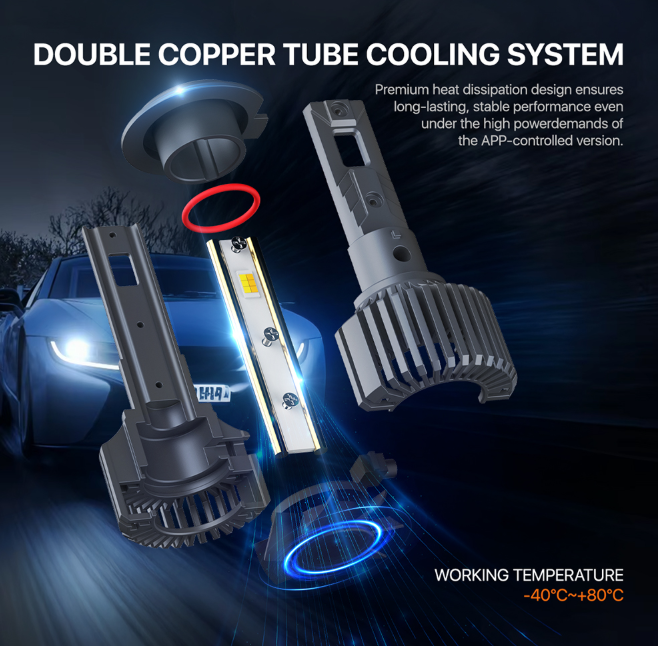
There are two primary cooling strategies in automotive LEDs:
Active Cooling
Active cooling uses small high-speed fans to move air across a heat sink.
Advantages:
Excellent heat removal efficiency
Maintains lower junction temperatures
Supports higher-output LED chips
Disadvantages:
Moving parts can fail
Fan bearings wear over time
Dust buildup reduces airflow
Passive Cooling
Passive systems rely on large heat sinks made from high-conductivity materials.
Advantages:
No moving parts
Silent operation
Fewer mechanical failure points
Disadvantages:
Requires more physical space
Limited cooling efficiency for very high-output LEDs
Material choice is equally critical.
High-quality LEDs use:
Copper-core PCBs (for rapid heat transfer)
Aviation-grade aluminum heat sinks
Advanced thermal interface materials
Cheap LED bulbs often cut costs by using thin aluminum boards and undersized heat sinks. The result? Heat builds faster than it can escape.
In headlight housings with restricted airflow, poor cooling design guarantees premature failure.
Conclusion: Buy for the Back, Not Just the Front
When shopping for LED headlights, most buyers focus on brightness numbers. But LED headlight heat dissipation matters far more than raw lumens.
Flip the bulb around. Examine the cooling structure. Look for robust heat sinks, quality materials, and proper airflow design.
Brightness is visible.
Cooling is invisible—but it determines whether your investment lasts five years or five months.
In LED lighting, the real performance isn’t in the beam—it’s in the Thermal Management behind it.


