Do LED Headlights Really Last 50,000 Hours?
18 April 2026
by Conpex
Reading volume: 613
“Lasts 50,000 hours!”
It’s one of the most common claims printed on LED headlight packaging. On paper, that number sounds almost unbelievable.
If a bulb ran continuously 24 hours a day, 50,000 hours equals nearly six years of nonstop operation.
In normal driving conditions, that would theoretically outlast the vehicle itself.
So why do some LED headlights fail in under a year?
To understand the real LED headlight lifespan, we need to separate marketing language from engineering reality.
The Science Behind the “50,000-Hour Rating”
First, let’s clarify what that number actually means.
Most reputable manufacturers base longevity claims on the L70 standard.
Under this standard, an LED is considered to have reached the end of its life when it drops to 70% of its original brightness.
That’s important.
It doesn’t mean the light stops working. It means it has experienced significant Lumen Depreciation—a gradual decline in output over time.
At L70, the LED still turns on, but it is noticeably dimmer than when new.
Second, the 50,000-hour figure typically refers only to the LED chip itself under ideal laboratory conditions:
Controlled ambient temperature
Stable voltage supply
No vibration
Perfect heat dissipation
Continuous operation
Those conditions do not exist inside a car.
In reality, an automotive LED bulb is not just a chip. It is a complex electronic system operating in a harsh environment.
The “Weakest Link” Theory
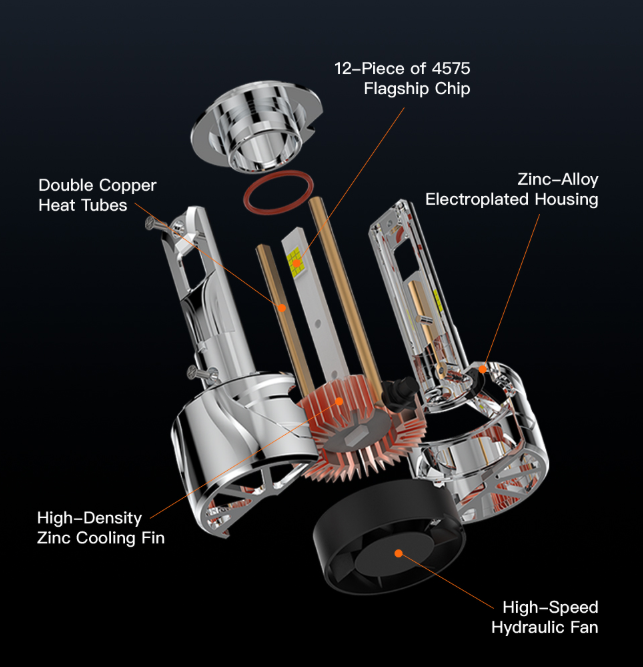
An LED headlight is a system composed of:
LED chip
LED driver (voltage regulation electronics)
Cooling system (fan or heat sink)
Housing and mounting components
While the chip might theoretically survive 50,000 hours, the rest of the system often does not.
The most common failure points are the LED driver and the cooling mechanism.
The driver is responsible for regulating voltage and current. Cars do not supply perfectly clean electricity.
Alternator fluctuations, startup surges, and voltage spikes constantly stress the electronics.
Cheap or poorly designed drivers overheat, degrade, or fail outright—often long before the LED chip itself shows wear.
Cooling fans are another weak link. Many aftermarket LEDs use small high-speed fans for thermal control.
These fans operate in high-heat, high-dust environments. Bearings wear out. Dust accumulates.
Once airflow is compromised, internal temperatures rise sharply, accelerating failure.
Think of it like a car engine. The engine block may be designed to last decades—but if the transmission fails in five years, the vehicle is still unusable.
Similarly, a durable LED chip is meaningless if the supporting components fail first.
Real-World Killers: Heat and Vibration
The biggest threats to real-world LED headlight lifespan are heat and vibration.
Engine bays are hostile environments. Ambient temperatures can exceed 80°C (176°F) near the headlight housing.
Poor thermal management in cars accelerates internal component degradation.
Elevated temperatures increase electrical resistance, stress solder joints, and hasten material breakdown.
Then there’s vibration.
Every pothole, speed bump, and uneven road surface sends micro-shocks through the headlight assembly.
Over thousands of miles, this mechanical stress weakens connections and electronic components.
Under these real-world conditions, even high-quality LED kits typically deliver a practical lifespan of:
5,000 to 15,000 hours
That’s still significantly longer than halogen bulbs (500–1,000 hours), but far from the marketing fantasy of 50,000 guaranteed hours.
Conclusion: What Should Consumers Expect?
So, do LED headlights really last 50,000 hours?
Technically, the LED chip might—under laboratory conditions. But in a vehicle, the entire system determines durability.
Realistically, a high-quality LED upgrade should last several years of normal driving, but not decades.
Instead of focusing on bold hour ratings printed on the box, look for:
Strong thermal design
Reliable electronics
A solid 2–3 year warranty
The hour number is theoretical.
Engineering quality is what actually determines lifespan.


