Active vs Passive Cooling: Which LED Headlight Design Lasts Longer?
09 April 2026
by Conpex
Reading volume: 444
LED headlights are often marketed as “cool” and energy-efficient. But here’s the engineering reality:
while LEDs are more efficient than halogens, a significant portion of the electrical energy they consume is still converted into heat—not visible light.
That heat must go somewhere.
Effective LED thermal management is the single most important factor in determining lifespan.
Today’s aftermarket LED kits rely on two primary approaches: active cooling (using fans) and passive cooling (using heat sinks and fins).
So when comparing active vs passive cooling LED headlights, which design truly lasts longer? The answer depends on environment, power level, and build quality.
Active Cooling: The Power of Forced Air
Active cooling systems use high-speed miniature fans—often spinning at 8,000–12,000 RPM—to pull heat away from the LED’s printed circuit board (PCB) and dissipate it into the surrounding air.
This “forced convection” method dramatically increases heat transfer efficiency.
Pros of Active Cooling
Supports higher wattage and higher lumen output
Compact design despite high brightness
Better heat control in tight headlight housings
Maintains lower junction temperatures under heavy load
Because airflow actively removes heat, active systems can sustain brighter LEDs in smaller packages—making them popular for performance-focused upgrades.
The Longevity Concern: Moving Parts
The downside is simple: fans are mechanical components.
Over time, dust infiltration, vibration, and bearing wear can lead to Mechanical Failure. When a cooling fan fails, heat builds up rapidly.
Without airflow, LED temperatures spike within minutes, potentially causing:
Sudden thermal shutdown
Driver circuit failure
Accelerated chip degradation
Fan lifespan varies widely. Cheap sleeve-bearing fans may fail within 6–12 months. Higher-end dual-ball-bearing fans can last significantly longer—but they are still wear components.
Active cooling is powerful, but it is not silent or invincible.
Passive Cooling: The Reliability of Silence
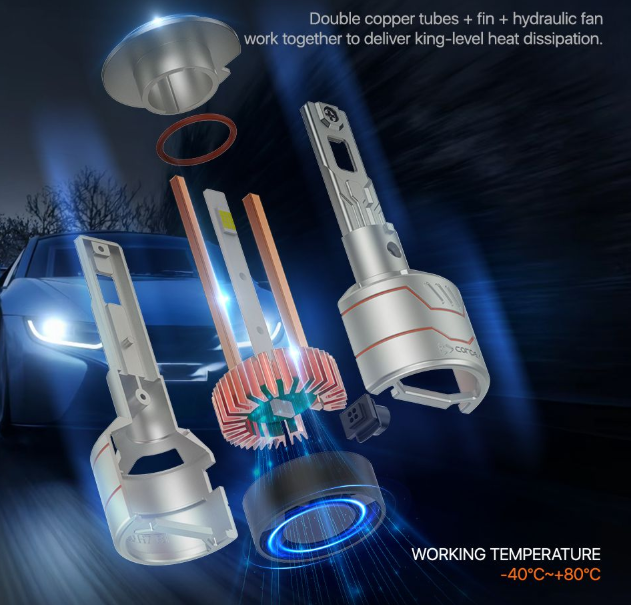
Passive systems rely on solid materials—typically aviation aluminum heat sinks, copper cores, or braided copper mesh—to dissipate heat naturally through surface area and airflow.
Instead of forcing air movement, passive systems use:
Large fin arrays
Thick aluminum bodies
Copper thermal pathways
This method is known as natural convection.
Pros of Passive Cooling
No moving parts
No fan noise
No mechanical wear
High resistance to dust and vibration
Lower risk of catastrophic failure
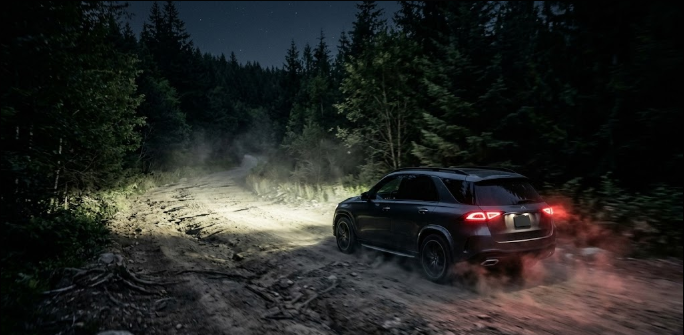
Because there are no fans, passive designs eliminate the risk of mechanical breakdown. This makes fanless LED headlights attractive for long-term reliability, especially in dusty or off-road environments.
The Longevity Concern: Thermal Saturation
Passive systems depend entirely on ambient air movement. In confined headlight housings with poor ventilation, heat can accumulate over time.
This leads to a slower form of failure: thermal degradation.
Instead of sudden burnout, the LED gradually loses brightness due to elevated internal temperatures—a process known as lumen depreciation.
To avoid overheating, passive designs often operate at slightly lower wattage. They may not achieve the same peak brightness as active systems, but they trade maximum output for stability.
Head-to-Head: Which Lasts Longer?
The answer depends on conditions.
In Dusty or Off-Road Environments
Passive cooling often wins. Without fans to clog or fail, there is no mechanical vulnerability. Dust and vibration are less likely to cause sudden issues.
In High-Performance or High-Wattage Applications
Active cooling has the advantage. High-output LEDs generate more heat than passive systems can realistically dissipate in small housings. Forced airflow is necessary to maintain safe operating temperatures.
However, longevity depends heavily on fan quality. Cheap active systems tend to fail abruptly. High-quality passive systems tend to degrade gradually.
In terms of Lumen Depreciation, passive systems usually lose brightness slowly over years, while poorly built active systems may suffer sudden failure when the fan stops.
Final Verdict: Which Should You Choose?
When comparing active vs passive cooling LED headlights, neither design is universally superior. Each has trade-offs.
For absolute long-term reliability—especially in daily driving, dusty climates, or tight housings—high-quality passive cooling is often the safer bet.
For maximum brightness in performance applications, active cooling is necessary—but only if the fan is premium-grade (preferably dual-ball-bearing) and well sealed.
Before choosing, inspect your vehicle’s headlight housing space. If airflow is limited, passive may struggle. If the space allows proper ventilation, both can perform well.
Ultimately, durability comes down to engineering quality—not just cooling style.


