Reflector vs Projector Headlights: What LED Upgrades Get Wrong
11 April 2026
by Conpex
Reading volume: 1096
Upgrading to LEDs is often marketed as simple “plug-and-play.” Swap the bulb, enjoy modern white light, and drive away happier.
But here’s the myth: not every LED works in every housing.
The core issue behind most reflector vs projector LED upgrade failures is optical mismatch.
Halogen bulbs are 360-degree light sources. LEDs are directional.
That fundamental difference is why some upgrades perform beautifully—while others create glare, dark spots, and disappointing visibility.
Understanding your housing type is more important than chasing higher lumen numbers.
Reflectors: The LED’s Hardest Challenge
Reflector housings were engineered around a tiny halogen filament positioned at a very specific location. That filament emits light in nearly all directions—full 360 degrees.
The chrome reflector bowl captures that omnidirectional light and redirects it forward in a controlled headlight beam pattern.
Every curve and angle inside the housing depends on that single glowing filament.
Now consider most aftermarket LEDs.
They typically use two flat chips mounted on opposite sides of a thin board—producing roughly 180 degrees of light on each side. That is not the same geometry as a halogen filament.
What happens next is predictable:

Portions of the reflector bowl receive no light at all (creating dark zones).
Other areas receive too much concentrated light (creating glare).
Light scatters unpredictably, increasing light scatter and glare for oncoming drivers.
The beam pattern loses its original shape and balance.
Because the reflector was never designed for a directional light source, the optical geometry breaks down.
This is why cheap LEDs installed in reflector housings often look bright from outside the vehicle—but provide poor road illumination.
Worse, excessive upward glare can make them unsafe and non-compliant in many regions.
Brightness without optical compatibility leads to uncontrolled luminous flux, not better visibility.
Projectors: A Better Match, But Not Perfect
Projector headlights operate differently.
Instead of relying purely on reflective surfaces, projectors use:
A bowl reflector
A convex lens
An internal shield that creates the cut-off line
The lens gathers and focuses light forward. The shield blocks stray upward light to protect oncoming drivers.
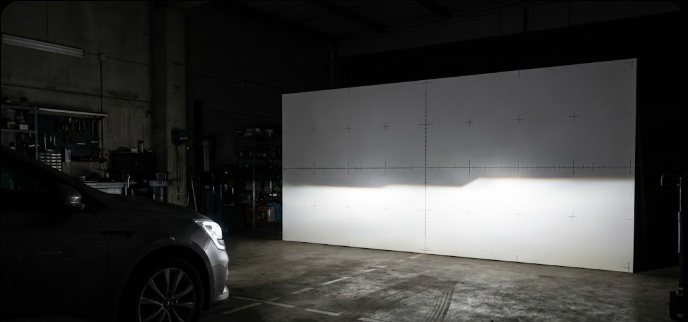
Because the lens re-focuses light, projectors generally handle LEDs better than reflectors do. The optical system has more ability to “correct” minor mismatches.
However, there is still a critical requirement: the LED chip must sit precisely at the projector’s focal point.
Even a 1 mm difference in chip placement can:
Shift the hot spot downward
Reduce long-distance throw
Increase foreground brightness
Flatten the beam pattern
The result? You see a lot of light near the bumper—but lose visibility 100 feet ahead.
Projectors are more forgiving—but they are not magic. Optical alignment still rules everything.
The #1 Mistake: Ignoring Bulb “Clocking”
Regardless of housing type, the most common installation error is incorrect LED bulb orientation, often called “clocking.”
LED chips should face left and right—at the 3 o’clock and 9 o’clock positions.
Why?
Because halogen filaments sit horizontally inside the housing. Aligning the LED chips this way best replicates the original light source geometry.
If the bulb is installed:
Vertically (12 and 6 o’clock), or
Diagonally
The beam pattern collapses.
You’ll see uneven light distribution, increased glare, and reduced distance visibility—even if the housing is a projector.
Proper clocking is non-negotiable.
Conclusion: Optics Over Output
The biggest mistake drivers make is assuming brightness fixes everything.
A 10,000-lumen bulb is useless if the housing can’t control it.
In any reflector vs. projector LED upgrade, success depends on compatibility, not raw output. Prioritize LEDs with:
Ultra-thin PCB boards
Chip placement that mimics a halogen filament
Precise alignment capability
Headlight performance is about optical precision, not marketing numbers.
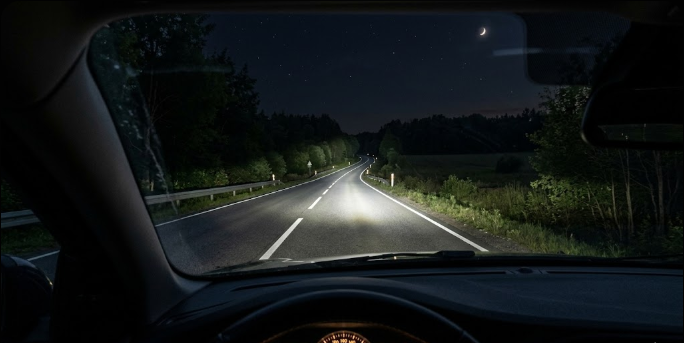
When upgrading to LEDs, respect the housing first. Because in automotive lighting, geometry always wins over power.


