Why Projector Headlights Matter More Than Bulb Brightness
08 April 2026
by Conpex
Reading volume: 701
Walk into any auto parts store or browse online, and you’ll see the same marketing message: “10,000 lumens!” “Super bright!” “Ultra white!”
It’s easy to fall into the Brightness Trap—believing that the highest-lumen bulb automatically delivers the best night driving performance.
But here’s the uncomfortable truth: without the right delivery system, raw brightness is often wasted—or worse, dangerous.
In the debate of projector headlights vs bulb brightness, the projector almost always matters more. Because light output alone doesn’t determine what you actually see on the road.
The “Floodlight” vs. “Flashlight” Analogy
To understand the difference between reflector and projector systems, imagine two tools.
A reflector headlight is like a floodlight. It uses a mirrored bowl to bounce light forward in many directions.
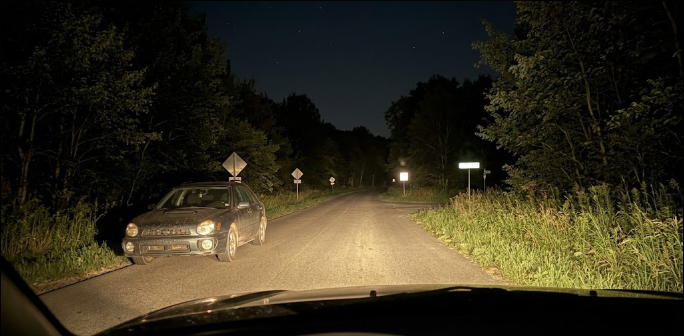
When designed correctly for its original bulb (typically halogen), it works reasonably well.
But when you simply install a more powerful bulb, that extra light often spreads everywhere—into trees, road signs, and oncoming traffic.
A projector headlight is more like a precision flashlight. It uses a focused lens and internal shield to control where the light goes. The lens gathers scattered light and concentrates it into a controlled beam.
This is the core difference between reflector vs projector systems:
Reflectors distribute light broadly
Projectors shape and focus light with Optical Control
If you install a super-bright bulb in a reflector housing not engineered for it, you don’t get more usable distance—you get more glare and foreground brightness. The road ahead may actually become harder to see.
Brightness without control is just scattered energy.
The Magic of the Sharp Cut-off Line
The defining feature of a projector headlight is the Cut-off Line.
If you’ve ever seen a factory projector beam against a wall, you’ll notice a razor-sharp horizontal line. That line is not cosmetic—it’s the result of precise optical engineering.
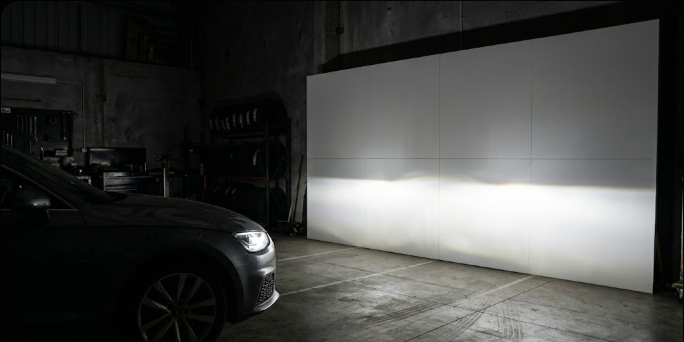
Here’s why it matters:
It prevents headlight glare from shining into the eyes of oncoming drivers.
It concentrates the brightest portion of the beam (the “hot spot”) exactly where distance vision is most critical.
Instead of wasting light above the horizon, a projector keeps illumination on the road surface. This improves long-range visibility while maintaining safety.
Without a controlled cut-off, extra brightness spills upward. That stray light doesn’t help you see farther—it simply increases glare and reduces contrast.
In night driving, precision placement of light matters more than total output. A perfectly shaped 3,000-lumen beam can outperform a scattered 8,000-lumen one every time.
Lux vs. Lumens: The Reality of Visibility
This is where marketing often misleads consumers.
Lumens measure total light emitted at the source.
Lux vs. Lumens is the distinction that truly defines performance.
Lux measures how much light actually reaches a specific point on the road.

You can think of lumens as “how much water leaves the hose,” while lux measures “how much water hits the target.”
A high-lumen bulb inside a poorly controlled reflector may look impressively bright when staring at the headlights. But if the beam pattern is flawed, lux levels at 50–100 meters down the road can be surprisingly low.
Meanwhile, a lower-lumen bulb inside a high-quality projector can produce stronger, more focused lux exactly where reaction time matters most.
Distance vision depends on intensity at range—not on raw output numbers printed on a box.
Invest in Optics, Not Just Bulbs
In the real world of night driving, brightness is only a tool. Projectors are the master.
A well-engineered projector assembly provides:
Superior headlight beam pattern
Controlled glare management
Concentrated long-distance illumination
Enhanced safety for you and others
Chasing bigger lumen numbers without upgrading optics is like installing a bigger engine without upgrading your brakes.
If you truly want a transformative improvement in nighttime visibility, prioritize a projector retrofit or a high-quality projector headlight assembly. Don’t just buy the brightest bulb on the shelf.
Because in lighting, precision always beats power.


