What Are the Potential Drawbacks of LED Headlights?
16 January 2026
by Conpex
Reading volume: 769
LED headlights are popular for good reasons. They look modern, promise higher brightness, and consume less power than halogen bulbs.
But before upgrading, it’s worth understanding the potential drawbacks of LED headlights, because many problems only appear after installation.
This is a practical, technical overview—no hype, just reality.
Optical Issues: LED Light Scattering and Beam Pattern Problems
Most factory-installed headlights are designed around halogen filaments, which sit at a precise focal point and emit light uniformly in all directions.
LED bulbs operate differently. Their diodes are flat, thicker, and emit light from a distinct geometric position. When fitted into halogen housings, this mismatch often causes:
Excessive LED light scattering
Uneven beam patterns
Bright hotspots close to the vehicle
Dark zones farther down the road
Increased glare for oncoming traffic
These beam pattern inconsistencies explain why some LED upgrades appear brighter yet actually diminish reduce usable nighttime visibility.
The Heat Paradox: Thermal Management in Headlights
LEDs are energy-efficient, but they are not completely heatless.
While they emit less forward-facing heat, LEDs generate intense heat at the diode base and driver electronics. To operate reliably over time, they depend on:
Oversized heat sinks
Cooling fans or heat pipes
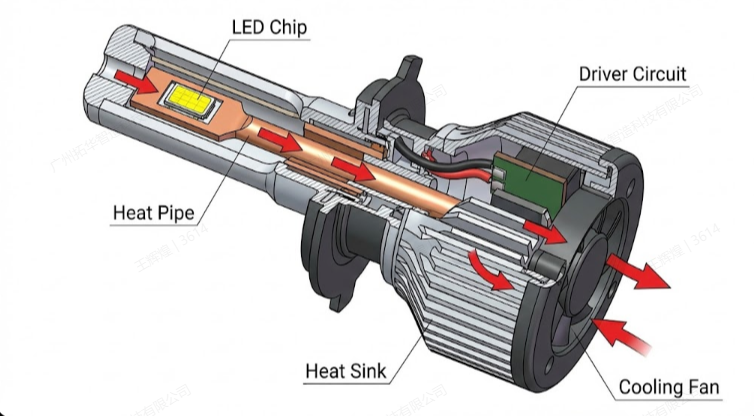
This creates several drawbacks:
Limited space inside headlight housings limits airflow,hindering heat dissipation
Cooling fans add mechanical points of failure
Inadequate cooling shortens LED lifespan or causes gradual brightness dimming
Thermal management is one of the most common failure points in LED headlight conversions.
Electrical Complexity: CAN Bus Compatibility
Modern vehicles electronically monitor headlight circuits.
Since LEDs draw less current than halogens bulbs, installing them can trigger false issues:
CAN bus error warnings on the dashboard
Flickering or pulsing headlights
Intermittent shutoff of headlight circuits
Some vehicles require additional decoders or resistors to resolve this, but CAN bus compatibility is highly vehicle-specific and far from guaranteed.
Safety and Etiquette: Glare and Real-World Visibility
Poorly aligned LED headlights can produce excessive glare, creating safety risks for other drivers.

At the same time, too much foreground brightness can hurt the driver as well:
Pupils constrict
Long-distance contrast decreases
Visibility worsens in rain or fog
Brightness without control often reduces real-world safety.
Economic Reality: Upfront Cost vs. Lifespan
High-quality LED kits come with a premium price tag-for good reason:they feature better diodes, robust cooling, and reliable electronics.
Budget kits often boast long lifespans but fail prematurely due to:
Subpar thermal design
Low-quality drivers
Cooling fan malfunctions
When weighing upfront cost against lifespan, a cheap LED kit may not outlast a high-quality halogen bulb.
Final Takeaway
The potential drawbacks of LED headlights include optical mismatch with halogen housings,
thermal management complexity, electrical issues compatibility, glare risks, and higher costs when quality is compromised.
LEDs can be a excellent upgrade—but only when:
Beam pattern is properly controlled
Thermal design is adequate for long-term use
Electrical compatibility with the vehicle is confirmed
Installation and headlight aiming are performed correctly
Before upgrading, look beyond lumen numbers. In headlights, precision matters more than raw brightness.


