Are Brighter Headlights Always Better? The Truth About Night Visibility
23 March 2026
by Conpex
Reading volume: 553
Most drivers assume that brighter headlights automatically mean safer night driving. After all, higher lumen numbers look impressive on the box.
But here’s the uncomfortable truth: night visibility vs brightness is not a simple equation. Visibility is governed by optics, beam control, and even human biology—not just raw output.
In many cases, chasing extreme brightness actually makes night driving worse, not better.
The Lumens vs. Lux Trap
Lumens measure the total amount of light emitted from the bulb.
Lux measures how much light actually reaches a specific point on the road.
This distinction matters.
A 10,000-lumen bulb with a poorly designed Beam Pattern may scatter light everywhere—into trees, road signs, and the eyes of oncoming drivers.
Meanwhile, a well-engineered 3,000-lumen system can concentrate light exactly where it’s needed, delivering higher Lux values at 50–100 meters down the road.
Think of it like a garden hose:
A wide spray wastes water.
A focused jet reaches further.
Headlights work the same way. Without proper optical alignment, high lumen output does not translate into usable road illumination.
The result? The road looks bright close to the bumper—but hazards further ahead remain invisible.
The Biological Factor: Pupillary Response
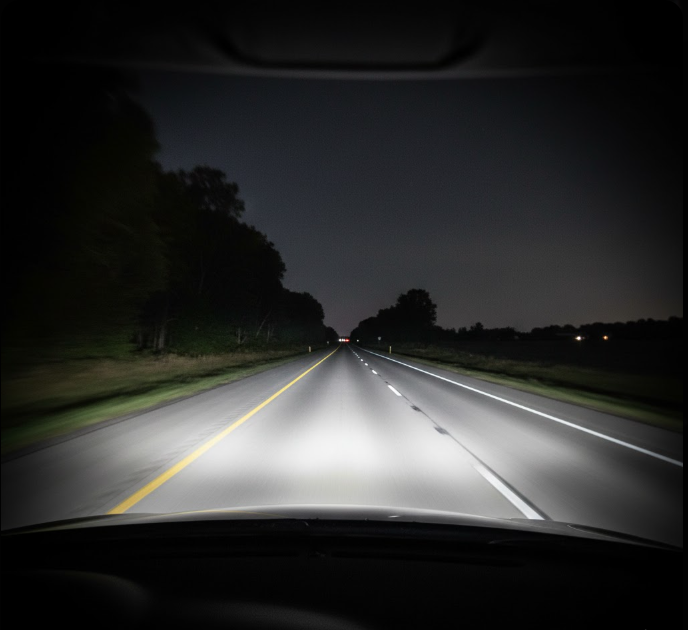
Lighting performance isn’t just about physics. It’s also about how your eyes react to light.
When you introduce excessive Foreground light—bright illumination directly in front of your vehicle—your eyes respond through Pupillary Response.
Here’s what happens:
Bright foreground light causes your pupils to constrict.
Smaller pupils reduce the amount of light entering the eye.
Long-distance contrast perception decreases.
In simple terms, when the area 10–20 feet in front of your car is overly bright, your eyes adapt to that brightness level. As a result, darker objects 100 feet ahead appear even dimmer.
This is why many drivers say:
“My headlights look bright, but I can’t see far.”
The issue isn’t lack of power—it’s poor light distribution.
Effective headlights balance foreground illumination with long-distance throw. Too much brightness close to the car actually destroys your distance vision.
The Danger of Glare & Contrast
Another overlooked issue is glare.
When light is scattered due to poor optics or improper installation, it creates:
Glare for oncoming drivers
Backscatter in rain or fog
Reduced contrast for the driver
Excessive scattered light doesn’t just annoy others—it reduces road safety.
Color temperature also plays a role. Many high-output LEDs operate at 6000K or higher, producing a blueish-white appearance. While this may look modern, cooler light reflects more off moisture, snow, and dust.
In adverse conditions, warmer tones (around 4300K–5000K) often provide better contrast and less visual fatigue.
Brightness without control increases glare. Glare reduces usable visibility.
What to Look For Instead
If you’re upgrading your headlights, focus on quality over quantity.
Instead of chasing high lumen numbers, prioritize:
A precise Beam Pattern
A sharp, controlled cut-off line
Verified Lux measurements at distance
Proper headlight alignment
Appropriate color temperature for your climate
The best lighting systems are engineered to deliver balanced illumination—strong distance throw without excessive foreground wash.
Night visibility vs brightness is about control, not brute force.
A well-designed 4,000-lumen system can outperform a poorly focused 10,000-lumen bulb every time.
When it comes to night driving safety, precision beats power.


