Why Halogen Headlights Sometimes Outperform Cheap LED Upgrades
25 March 2026
by Conpex
Reading volume: 976
The modern white glow of a $30 LED kit can be tempting. It looks brighter. It looks newer. It looks like an instant upgrade.
But when it comes to halogen vs. cheap LED headlights, appearance can be misleading.
Many drivers fall into what engineers call the “White Light Trap”—assuming that a cooler color and higher advertised lumens automatically mean better night vision.
In reality, headlight performance is governed by optics, not aesthetics. And in many cases, your factory halogen system may deliver safer, more usable light than a poorly designed LED retrofit.
The Optics Gap: Focal Point Precision
Headlights are not just light sources—they are optical systems.
Factory halogen housings are engineered around a very specific focal point: a tiny tungsten filament suspended precisely inside the bulb.
This filament emits light in a near-360-degree pattern, and the reflector or projector housing is designed to capture and shape that light into a controlled beam.
Cheap LED upgrades often fail here.
Instead of a fine filament, many low-cost LEDs use bulky, flat-mounted chips placed on thick circuit boards. These chips cannot perfectly replicate the original optical geometry of the halogen filament.
The result?
A defocused beam pattern
Light spilling upward into trees and signs
Uneven illumination across the road
Increased glare for oncoming drivers
Instead of a sharp, controlled cutoff line, the beam becomes scattered and imprecise. And in night driving, precision is everything.
Lumens vs. Lux: The Visibility Reality
Low-cost LED kits often advertise extremely high lumen numbers—8,000, 10,000, even 12,000 lumens per pair.
Here’s the problem: lumens measure total light emitted at the source. They do not measure how effectively that light reaches the road.
Lux, on the other hand, measures light intensity at a specific point—like 50 or 100 feet ahead of your vehicle. That’s what actually determines reaction time and visibility.
Cheap LEDs may produce high lumens but low usable lux because the beam is poorly focused. Much of the light ends up:
Concentrated in the foreground (right in front of the bumper)
Scattered to the sides
Reflected into the eyes of other drivers
This creates the illusion of brightness while reducing long-distance throw. The road appears bright close to the car, but hazards farther ahead become harder to detect.
A well-designed halogen bulb, despite lower raw lumens, often delivers stronger and more consistent lux on the road surface.
The Weather & Glare Factor
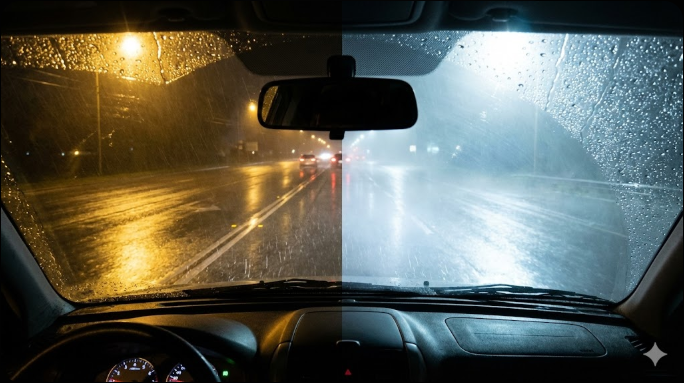
Weather conditions expose weaknesses in cheap LED systems even more clearly.
Halogen bulbs typically operate around 3000K, producing a warm yellow light. This warmer tone reduces backscatter in rain, mist, and snow. It also produces less harsh glare.
By contrast, many inexpensive LED kits emit 6000K–6500K blue-white light. Shorter wavelengths scatter more easily in moisture and airborne particles. The result:
Increased glare in wet conditions
Reduced contrast on reflective road surfaces
Eye fatigue during long drives
Worse still, a poorly controlled beam can blind oncoming drivers. That’s not just inconvenient—it’s a genuine safety hazard.
Conclusion: Quality Over “Curb Appeal”
When comparing halogen vs. cheap LED headlights, the key lesson is simple: precision beats raw output.
A high-performance halogen bulb from a reputable manufacturer—such as an upgraded Philips or Osram—often provides better beam control and safer night visibility than a generic marketplace LED kit.
If you decide to upgrade to LEDs, invest in precision-engineered systems designed to replicate proper focal alignment and beam control.
Otherwise, sticking with a quality halogen setup may be the smarter—and safer—choice.
In automotive lighting, real performance isn’t about how bright it looks. It’s about how well it lets you see.


