Is Upgrading to LED Headlights Worth It for Older Cars?
26 March 2026
by Conpex
Reading volume: 1228
If you drive a 10- or 15-year-old car, you probably know the feeling. The headlights look yellow. The beam seems weak. On dark backroads, you find yourself leaning forward, squinting into the night.
This “Dim Bulb Syndrome” is common in older vehicles. Aging halogen bulbs, oxidized lenses, and worn reflectors all reduce usable light.
So the question becomes: Does upgrading older cars to LED headlights actually make sense—or is it just throwing modern tech at an old platform?

The answer depends on safety needs, electrical condition, and expectations.
The Case for “Yes”: Safety and Efficiency
For many daily-driven older cars, an LED upgrade can be a meaningful safety improvement.
Better Visibility
Modern LED systems typically produce significantly more usable light than worn halogen bulbs. Even without chasing extreme brightness, a well-designed LED can:
Increase forward visibility
Improve contrast on road markings
Make signs and hazards easier to detect
For drivers who frequently travel on poorly lit roads—or for older drivers whose night vision has declined—this improvement can be substantial.
Reduced Electrical Load
Older vehicles often have aging wiring and alternators. Traditional halogen bulbs draw relatively high amperage (electrical current).
Over time, heat and resistance in the wiring harness can reduce voltage at the bulb, further dimming output.
LEDs consume less power while producing more light. That means:
Lower strain on the alternator
Less heat in factory wiring
More stable voltage supply
In practical terms, this can actually help preserve the electrical system in older cars.
From a cost-benefit perspective of LED retrofit, safety and reduced electrical load are strong arguments in favor.
The Technical Hurdles
Upgrading older cars to LED headlights isn’t always plug-and-play. There are real limitations to consider.
Reflector vs. Projector
Most older vehicles use reflector housings designed around a tiny halogen filament. That filament sits at a precise focal point. Reflectors bounce the light forward in a controlled pattern.
LED chips are flat and directional. If they are not positioned correctly—often called “clocking” the bulb at the 3 and 9 o’clock position—the headlight beam pattern can become distorted.
Common problems include:
Excessive glare to oncoming drivers
Bright foreground but poor distance throw
Dark spots farther down the road
This is why LED vs. halogen for old cars is not just about brightness—it’s about optical precision.
Housing Condition Matters
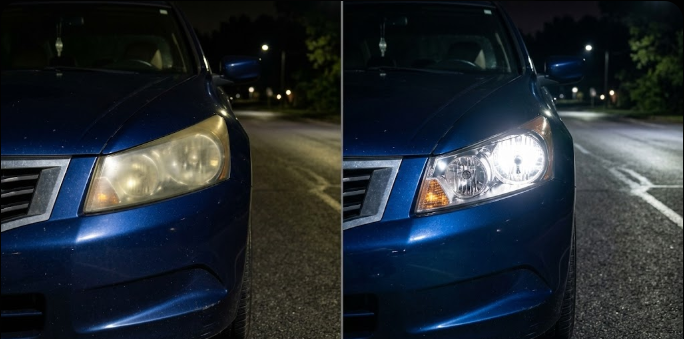
An LED bulb will not fix a cloudy lens.
If your headlight cover is yellowed or oxidized, light output is already compromised. Before considering LEDs, perform a proper classic car headlight restoration:
Polish or sand the lens
Apply UV sealant
Check reflector condition
Clear optics are step one. Always.
Electrical Compatibility
Even some mid-2000s vehicles have basic monitoring systems. In these cases, LED installations may cause:
Flickering
Dashboard warnings
A simple decoder or resistor harness often resolves this, but it’s something to plan for.
The Cost-Benefit Analysis
A quality LED kit is not cheap. For a 15-year-old car worth a few thousand dollars, spending several hundred dollars on lighting may feel excessive.
Ask yourself:
Is this a daily commuter?
Do I frequently drive at night?
Are safety upgrades a priority?
For a well-used daily driver, improved visibility can easily justify the expense.
For a collector or show car, aesthetics matter. Ultra-white 6000K LEDs may not look “period-correct.”
In that case, warm-white LEDs (around 4300K–5000K) provide a more traditional appearance while improving performance.
Pre-Upgrade Checklist
Before upgrading, review this:
✔ Restore cloudy lenses first
✔ Check headlight housing type (reflector or projector)
✔ Confirm sufficient space for LED cooling components
✔ Plan for proper beam alignment after installation
✔ Consider warm-white options for classic aesthetics
Final Verdict
So, is upgrading older cars to LED headlights worth it?
For daily drivers struggling with dim factory lighting, the answer is often yes—if done properly.
A high-quality LED system, installed with correct orientation and alignment, can dramatically improve night driving safety.
But LEDs are not magic. Clear housings, proper beam control, and electrical compatibility are essential.
When safety is the priority and the installation is done correctly, upgrading older cars to LED headlights can be one of the smartest improvements you make.


